


There’s something about my Threads algorithm that I’ve crafted that is reminiscent of my early days on Twitter, now X. Provided that I don’t begin to hyperfocus and end up there for hours, It’s often a welcome reprieve from my day to day movement.
It’s also often where I find myself traveling down food history rabbit holes.
Around this time last month, I was online and I happened on this thread about Korean Fried Chicken and its unknown history - that it originated with Korean soldiers learning from their Black American counterparts during the Korean War.
Now. I’d originally learned about this some time ago, in part from my own reading, in part from a quick quip from Food Network chef and resident food scientist Alton Brown while he was hosting an episode of Iron Chef.
That said - the thread went slightly off the rails when both other people began chiming in about the origins, and it got fairly intense at some point:


Which, of course, led me to my latest ADHD coded, hyperfocused rabbit hole:
How did Korean fried chicken become a part of Korean culture? And, more importantly, why does the honest answer to that question always prompt a response akin to “we’re more alike than we are separate”? Or cause such vitriol?
Especially if the answer happens to be Black people?
Before We Get Into It
What’s important to name, first and foremost, is that fried foods have existed for centuries, in many cultures, across multiple countries around the world. Starting down this particular rabbit hole is not about pointing to any one particular culture or race as the originator or creator of a popular food dish, especially as it pertains to something as universal as fried chicken.
It is, however, identifying a recurring pattern that often happens when a marginalized culture or race revolutionizes something, be it food or not, which then becomes accessible to a large audience.
Having said all of that: to get to the answer to my question, I think it’s important to go backwards and talk about the history of fried chicken as a whole first.
It Started With a Bird
The documented history of where fried chicken originated is often categorized as murky. To me, it’s less about that, and more about recognizing that it, like many foods, started in multiple places before finding a common preparation. In much of West Africa, foods like the black eyed pea based fritter akara, the sweet treat puff puff, and spiced yet sweet kelewele, or plantain, have been fried in palm oil for centuries. Fried fish is a staple across practically every country in Africa, and chicken was often fried in heavily spiced bites and sold as a street bite.
But this fried chicken is not the fried chicken that most of us identify with - it is not breaded, but fried in the style of a fricasee. You can see evidence of the migration of this style of cooking as a direct result of the transatlantic slave trade in countries like Haiti, with dishes like pous fri, or like the chicharron de pollo of Latino countries like the Dominican Republic, the latter of which is more similar to what we commonly recognize as fried chicken.
And then you have the first documented instance of the fried chicken that we are more familiar with from the most unlikely place - Scotland.
I’ve talked about this before, when I wrote
When The Food Travels Without Us

Our food has an unfortunate tendency to become “worthy” once we are removed from it.
When The Food Travels Without Us. There, I mentioned how culinary historian Adrian Miller wrote about it originating from Scottish settlers to the US in the 1700s. Miller goes on to explain that in his studies of the trail of fried chicken, he read from another food culturist about biographer James Boswell’s diary entry from 1773, where he recaps enjoying a fried chicken dinner with friends on the Scottish coast.
Following the trail, you have Southern cooks picking up the recipe and making it, evolving it eventually into the fried chicken we often know and love in present time. I’ve talked about this, too, with housewife turned cookbook author Mary Randolph, who wrote and published The Virginia House-Wife in 1824.
Specifically, I said this: “It is a well known fact that in wealthy or well to do households in the South, the enslaved Black people were mostly the ones who did the cooking.” Which, of course, led me to this question, ultimately:
“It simply is a spotlight on how erasure is systemic. Is it Randolph’s recipe that gained popularity? Or is it the recipe of enslaved Black people who ran her kitchens?”
Why There Are No Cookbooks
Highlighting enslaved Black Americans being the driving force behind the food that shaped American culture, and, in many cases, global food trends, is often met with a lot of skepticism.
The most common of this? “Where’s the evidence? Where are the cookbooks? The documented history?”
History itself can answer this question better than I can.
In September of 1739, Jemmy Cato, a Congolese born, literate enslaved man, recruited anywhere from 60 to 80 fellow enslaved people and led a revolt in the South Carolina low country that lasted close to two weeks, unaliving dozens of their enslavers, before they were ultimately captured and either sold to islands across the Caribbean, or killed themselves. The resulting legislation, starting with the Negro Act of 1740 in South Carolina, prompted multiple similar anti-literacy laws across the Deep South.
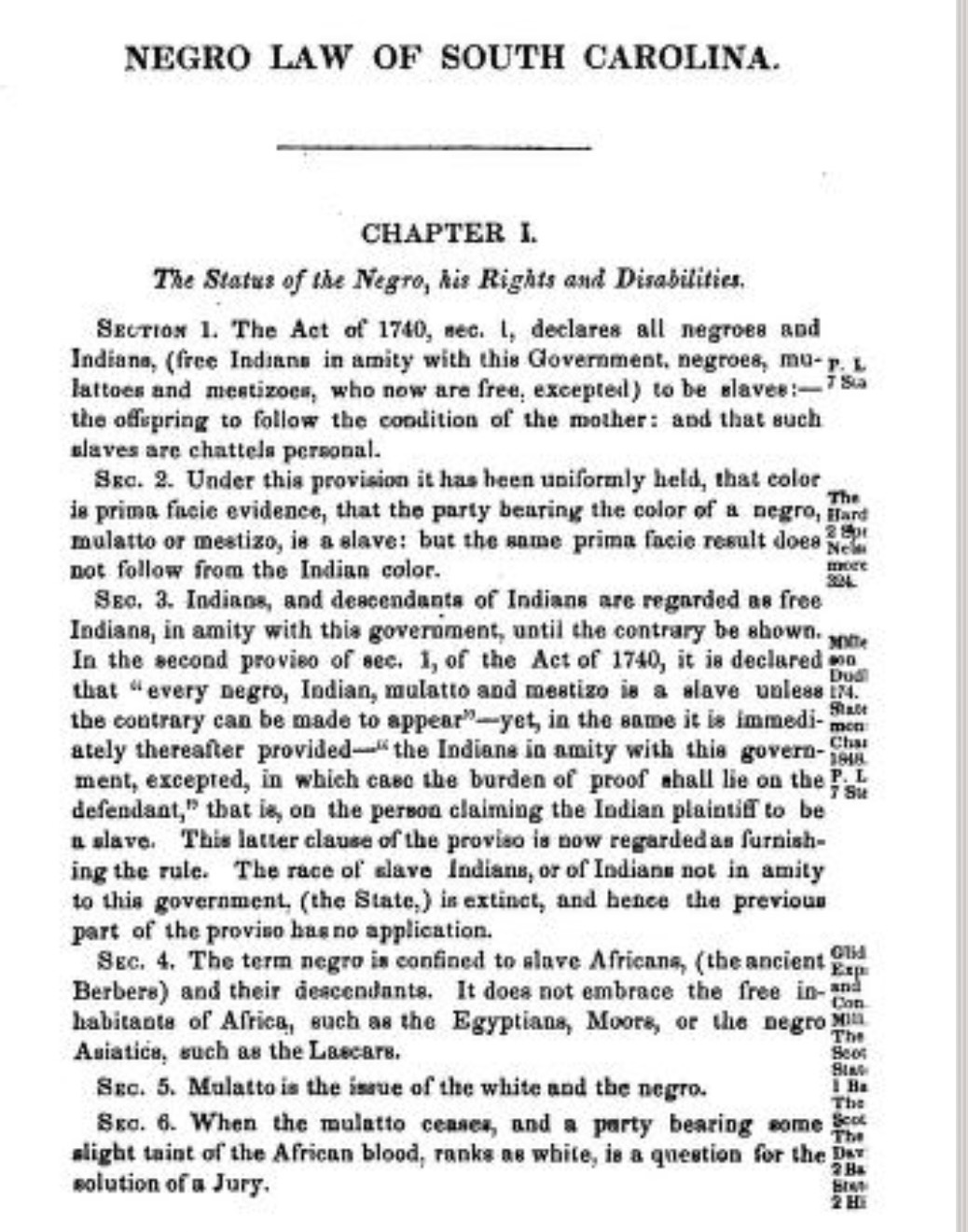
Their aim? To curb education that led to paths to freedom, and to avoid future similar uprisings.
Violation of the law depended on the race of the offender, and was noted to be anything from steep fines to death.
Historically in African cultures, history is often passed orally, via the community or tribe griot, first as a means of connection, and then as a means of survival. When Africans were captured along the West & Southwest coasts of Africa, and placed in parts of the Caribbean, with the bulk landing in the South, the griots used this oral history to ensure that the legacies they brought from the countries they were taken from, continued to be passed along.
That said - Africans who were forcibly brought to the Americas had little to no choice but to continue to pass along their traditions orally, if for no other reason than they were forbidden to read or write. The Black Americans that were born of these African ancestors adopted the method as well.
With the passage of these anti-literacy laws, it was a guaranteed way of ensuring that they had no other means of documenting their own legacies - which also included their recipes, their spices, and their methods of cooking.
This made it much easier for their contributions to be erased, because how do you prove something happened if the only proof that exists is word of mouth?
Both enslaved and freed Black Americans defied every odd, with underground schooling, newsletters such as Frederick Douglass’ North Star, and The Monitor, were often used as a means to continue to circulate important information amongst the Black American community. But even within that, the anti-literacy laws created a lasting impact on how Black America is credited for their contributions.
Which, of course, carries over into the food.
The Fried Chicken Trains, The Colonel, and The Gospel
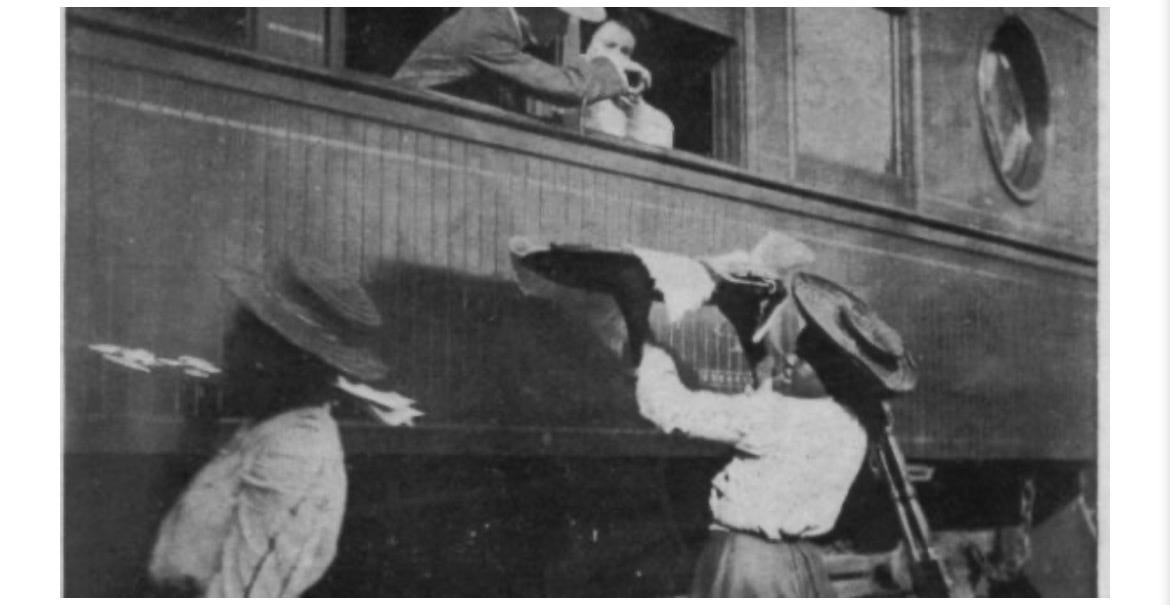
We’ve established that history is often the best storyteller of how systems erase contributions - and no more so does that pattern exist, than in the case of the Fried Chicken Trains in Gordonsville, VA.
At the height of the Civil War, the town of Gordonsville was a major hub for transportation to and from the DMV area, as well as a major port for transport for produce from the Shenandoah Valley. Due to the fact that the trains that passed through had no dining car, Black women ‘waiter carriers’ capitalized on the opportunity by making and selling fried chicken dinners, as well as other treats like biscuits and pies to the riders, passing the meals through the train windows as they came by.
It created a boon for fellow entrepreneur minded Black women to do the same, and fried chicken dinner boxes popped up all over the deep South.
You’ve heard of the fried chicken box in another place before - the pressure fryer cooked fried chicken, popularized by Colonel Harlan Sanders - his chicken was originally started with a small six seat restaurant, at a gas station, in North Corbin, Kentucky.
You probably know it as another brand - Kentucky Fried Chicken.
I will never say that the Colonel’s original recipe was taken from these hard working Black women who took something that they were inherently good at, and made money from it. Not only is there no proof of that (and I have zero desire to open myself up to a libel lawsuit from global conglomerate Yum! Brands), but, more importantly, that’s not why I bring it up.
I bring it up simply to show you the ongoing pattern.
Eater contributing writer Madeleine Davies points out the pattern too, in her piece Food, Fame & Fried Chicken:
“But as we’ve seen throughout history, where goes Black success, opportunistic white people will follow to appropriate it. Among those white people were Harlan Sanders, now better known as Colonel Sanders, who — marketing plantation imagery — would go on to open the first Kentucky Fried Chicken in 1930 in Corbin, Kentucky, a town that John T. Edge of the Southern Foodways Alliance (SFA) describes as “ ‘a sundown town — in other words, a town where Blacks were welcome during the day but not at night.’ ” "
As we all know from history and popular culture, this first restaurant is what paved the way for the global enterprise known as KFC.
Yet it is the irony of Black Americans being vastly critiqued, mocked even, in racist caricatures of overexaggerated features dining in plantation grounds, on large slabs of watermelon and giant pieces of fried chicken - only to then build a globally recognized brand that prominently features much of what they were ridiculed for.
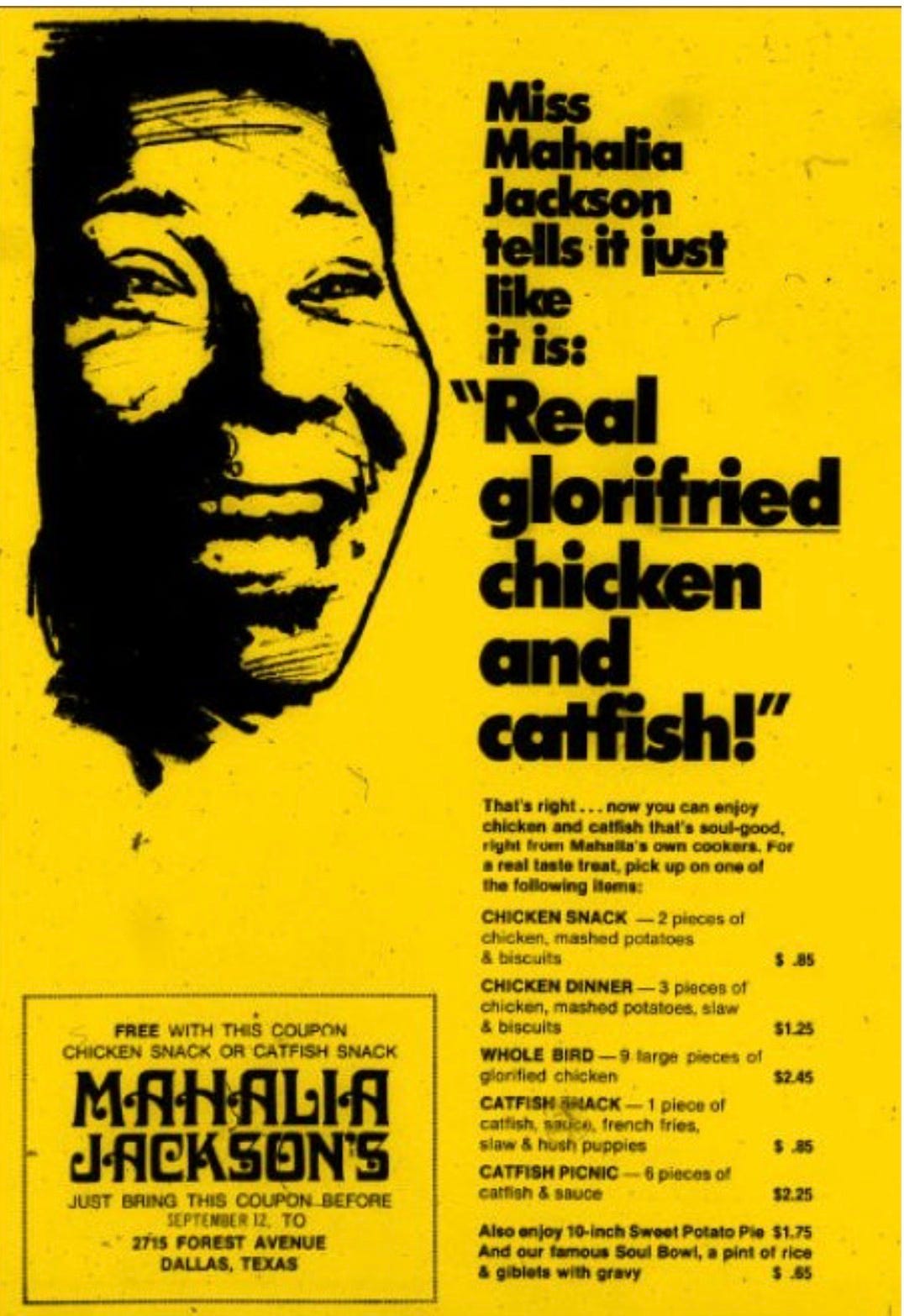
It’s not as if to say that Black women didn’t try to open their own chicken restaurant franchise. Gospel singer and civil rights activist Mahalia Jackson opened Mahalia Jackson’s Glori-Fried Chicken as a means for financial empowerment for the Black community, as well as great tasting food. At its height, the business offered fair wages, insurance, education and vocational training for both entry-level and management workers.
Gentrification, redlining, and both intentional and unintentional violence in the areas where Jackson’s chicken franchise grew to were the catalyst for their closure.
On the whole, the American fried chicken conglomerate, as we know it, is similar to other popular food chain businesses whose marketing have brought it vast riches and wealth - it is built on a foundation that was used without credit or compensation, scaled into a billion dollar brand, and sold back to the culture it came from.
And the pattern remains that the people who often end up receiving the short end of the stick all tend to be of the same diaspora.
Choosing to find ways to dispute that is less about the information being presented, and more about the discomfort that said information brings to the forefront.
With all that said - let’s talk about the other KFC for a minute.
Korean Fried Chicken and the Soldiers
There has been a lot of discourse surrounding the origins of Korean fried chicken, particularly because if you’ve ever had the pleasure of enjoying a piece, one of the first things you realize is that it is not like Southern fried chicken in the least. Korean fried chicken has its own recipe, its light and crispy double fry method now synonymous with its uniquely defined way of preparation.
It didn’t start off that way, though.
The conversation surrounding its origins often stem from the argument that Korean people have been frying foods for hundreds of years - which is where I decided to go down the rabbit hole for myself. As someone who is an avid lover of all things Korean food, having been one for a long time, I was deeply curious.
Food journalists Alkira Reinfrank and Bernice Chan, hosts of the popular (and award winning) Eat Drink Asia, were able to trace the origins of Korean fried chicken to the barracks during the Korean war. As the story goes, Black American soldiers only had chicken to prepare as opposed to turkey during the Thanksgiving holiday, so they opted to fry the chicken, sharing it with their Korean counterparts.
This was during the 1940’s and 50’s, when chicken in preparation in Korean households and restaurants was primarily stewed or steamed in flavorful broths.
Prior to this moment, the most commonly known version of fried chicken that originated in Korea was called “pogye”, a type of chicken that is stir fried and then glazed in a sweet and tangy sauce. It first appeared in the 15th century cookbook Sangayorok.
There were other methods of preparation for chicken, of course, but domestic chicken production in Korea was not as popular then as it is now, for any number of reasons. A rotisserie style known as “tongdak” became very popular, albeit considered a bit of an indulgence. In the beginning, chickens were often fried whole, with the way that we see Korean fried chicken now not presenting itself until the 1970’s.
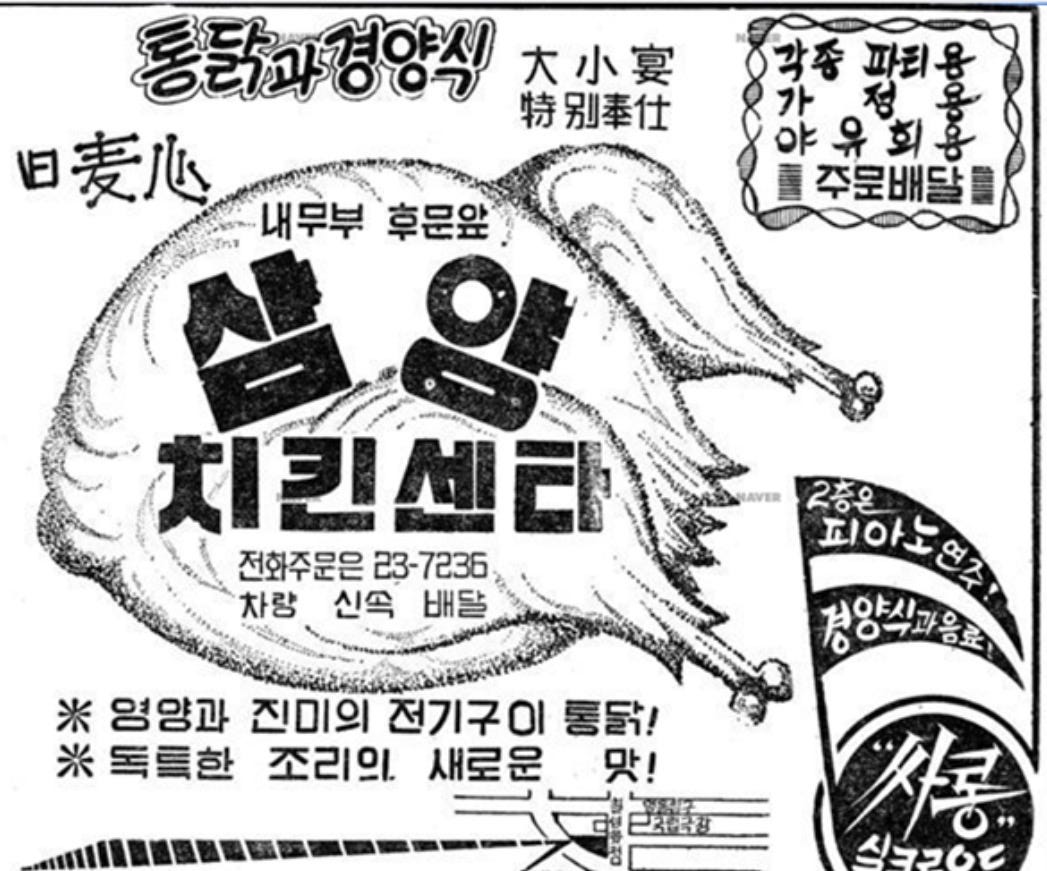
It’s also worth noting that war often decimates more than physical bodies - the cost of war on a country’s economy is always a hugely taxing toll. The Korean War was no different. Chicken, cooking oil, those items became hot (and expensive) commodities, ultimately slowing the spread of the fried chicken phenomenon.
Despite all of these elements, spread it did.
The Miracle on the Han River, a period of rapid expansion and industrialization, pushed what is now South Korea forward in innovation and access, allowing for things like oil to become much more accessible to the general population. This brought the other KFC to the forefront, with restaurants dedicated to the now assimilated and adapted recipe popping up.
They even beat the ‘first’ KFC to the punch, opening Lim’s Chicken, a fried chicken franchise, in 1977.
So Korean fried chicken is absolutely its own unique thing. Now.
What is less talked about? How it came to be.
The argument is distinct. Korean fried chicken started with the Southern Black version of fried chicken. And, with many other things that Korean culture has embraced historically, they have taken outside influence and made it their own. There is nothing wrong with that. It is something that every single culture across the globe has done at one point or another.
It is more so about who is often hidden in the process.
Black recipes are consistently hidden in the process.
And I cannot stress this enough. Korean culinary creativity is real. It’s remarkable. I enjoy Korean food immensely. But honoring it fully - honoring any country’s culinary traditions fully - means telling the complete story. Not just the innovative parts, but also the parts that aren’t as marketable.
“We’re All More Connected Than We Are Separate”
This is a phrase that has irked my spirit and soul for a long time, because it glosses over so much.
I mean, at face value, I suppose it’s accurate - we are.
It is also a balm to avoid an uncomfortable conversation that often prompts the descendants of colonizers to be defensive, and the descendants of the colonized feeling as if they have to tiptoe around their inherited trauma.
The vast majority of our culinary connections originate from established countries, people, and practices being colonized. Those who were colonized have often risen above and turned their lemons into lemonade over time, and it is a beautiful thing.
I think about some of my favorite dishes to eat growing up: doubles from Trinidad and Tobago. Sweet potato pudding from Barbados. Good old Southern macaroni and cheese.
All of these foods exist because my ancestors were colonized and took the recipes that they were forcibly brought and made them their own.
Asian countries like Korea have a similar problem. It could even be argued that the precursor to North and South Korea as we know it stems from Japanese colonization. It could also be argued that Japan was looking to keep up with their European colonizer counterparts.
But that’s a rabbit hole for another time.
The point of it all is, using “we are all more connected than we are separate” is a mechanism of the original thing that divided each of us in the first place. It also keeps the mechanism going - and it determines who gets credited today in real time.
Who gets the cookbook deal.
Who receives funding faster.
Who has an easier time of building the billion dollar business, or landing the franchise deal.
And while each of us who were colonized all have very similar stories…only one group of us has a continually lasting impact that is combatted daily.
You can trace many of the other traditions and recipes back to other countries. We talked about Scottish fried chicken and the evidence therein, because there’s documented evidence. I was able to share all that I was about the history of Korean fried chicken with you, because there is documented evidence.
But for centuries…most Black Americans were denied the ability to read, write, or pass information along via a documented means, as a direct result of the transatlantic slave trade. That much is in history books (for now). If it were not for the griots, for the elders over the centuries, who passed along their oral traditions, there would be even more that we would not know to this day.
But who says that oral traditions don’t hold the same gravitas as written ones?
They survived the Middle Passage, no? The Jim Crow era? Did oral traditions not shape the voices who echoed our history through song and dance?
Now having gone down this particular rabbit hole, does this change the deliciousness of Korean fried chicken? Not at all. I’m looking for an excuse to head to K-town for some as I write at this very moment.
But I believe in offering perspective, and I believe even more in amplifying the voices and histories of those whose voices have often been stifled.
Strange Fruit was not a song about food. Its spoken history carries power - power that deserves to be heard in every aspect of the Black American lived experience.
The oral traditions of the food that we originated never seem to show up in the footnotes of the history that is then written, disseminated, and ultimately sold.
We have to collectively decide that it should.